
Key Issues (Materiality)
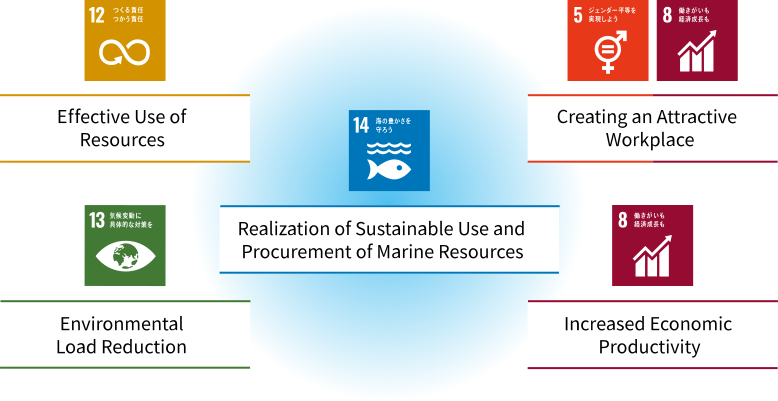
In 2018, in order to realize sustainable management, we investigated and examined the importance of addressing various social issues from the perspective of all stakeholders, including TOREI's business, employees, and suppliers, and identified five key issues (materiality).
Steps to identify key issues (materiality)
Based on the "SDG Compass," we have identified key issues (materiality) for solving social problems and contributing to the SDGs.
-
STEP01
- With SDGs
Organizing relationships - This document outlines the relationship between TOREI's business activities and the 17 SDGs and 169 targets (opportunities and risks in business activities).
- With SDGs
-
STEP02
- Issue extraction
- We identified and grouped the challenges necessary to achieve sustainable management.
-
STEP03
- Importance Assessment
(Identifying materiality) - Based on the issues identified in Step 2, their importance is determined based on factors such as the relationship with stakeholders and the degree of impact. As a result, we identified five material issues that we should focus on.
- Importance Assessment
-
STEP04
- Goal setting and
Planning and Approval - For each identified material issue, action targets and plans are formulated and approved by the management body.
- Goal setting and
Five key issues (materiality)
Following the process of identifying key issues (materiality), among the five key issues selected, "Sustainable use and procurement of fishery resources" is positioned as the most important issue that must be addressed as it is fundamental to the continuity of our business.
Key challenges in sustainable management
Numerical targets related to sustainable management
In 2021, in order to clearly demonstrate TOREI's approach to sustainable management and to promote initiatives with shared goals, we formulated "Numerical Targets Related to Sustainable Management."
The numerical targets are a simplified version of the "TOREI Group's Business Philosophy" and "Materiality," with some of these elements being formulated as goals.
Some of our numerical targets include TFL (*), and we are promoting sustainable management within the TOREI Group.
(*) Toyo Refrigerated Food & Logistics Co., Ltd.
| Goal item | Achievement target year | base year | Achievement goal | |
|---|---|---|---|---|
| Ratio of female managers (%) |


|
2030 | - | 25% |
| Occupational accident statistics (severity of lost work time) |
|
2030 | - | 0.13 |
| Productivity (profit / working hours) | |
2030 | Five-year period from fiscal year 2016 to fiscal year 2020 | 250% |
| Certified product procurement rate |  |
2030 | - | 20% |
| GHG emissions per unit of total assets |  |
2030 2050 |
2020 | ▲30% ▲70% |
| Amount of fluorocarbons contained in equipment (in CO2 equivalent) | |
2030 2050 |
2020 (As of April 2021) |
▲35% ▲95% |
Partially revised in March 2026