TOREI's Sustainability
Basic idea
Global social and environmental issues such as climate change, resource problems, and human rights issues are complexly interconnected and are progressing day by day. Against this backdrop, the Sustainable Development Goals (SDGs) were established as a vision for the world by 2030, in order to address major economic, social, and environmental challenges. Companies are expected to proactively address these challenges, contribute to a sustainable society, and achieve sustainable growth themselves.
Since its founding, TOREI has been a company that develops businesses that bring the bounty of the sea to people's tables. Since 2006, we have adopted an "Environmental Management Policy," obtained Eco Action 21 certification, and have been working on various environmental action plans. However, with global problems and social risks on the rise, there is a growing need to implement sustainable management and business activities with greater speed and efficiency.
Focusing on solving various social issues, and with the mission of TOREI and the core of its business being the "sustainable and stable supply of marine resources," the entire group will work together with all stakeholders to further promote sustainable management so that the blessings of the sea can be sustainably delivered to future generations.
Environmental Management Report
At TOREI, we strive to improve the sustainability of our business by considering environmental, social, and economic sustainability. To help people understand these initiatives, we create and publish an environmental management report every year.
Environmental Management Policy
Our Environmental Management Policy is based on the TOREI Group's Business Philosophy and outlines our basic guidelines regarding environmental management and initiatives, serving as a commitment to society. Our environmental management policy defines our basic philosophy, as well as the activities and areas we will focus on based on our business operations, and uses this to formulate our medium- and long-term activity plans and goals. Our environmental management policy is reviewed at the end of each fiscal year, and we consider the need for revisions. Furthermore, we have separately formulated "Environmental Management Goals" and "Environmental Management Plan" as concrete action plans for realizing our environmental management policy.
- Environmental Management Policy
-
● Basic philosophy
Recognizing that companies that do not consider the global environment cannot survive, we contribute to the development of a better society and actively and sincerely engage in the preservation and improvement of the global environment in all our business activities, including procurement, processing and manufacturing, storage, logistics, sales, and services.
● Priority areas for environmental initiatives
- 1. We will always be aware of the environmental aspects of our business activities, promote the reduction of environmental impact, including greenhouse gas emissions, and strive for continuous improvement of our sustainable management practices.
- 2. We will comply with all environmental laws and regulations, and act in accordance with international codes of conduct. We will identify and analyze environmental risks associated with our business activities, such as violations of environmental laws and regulations and environmental accidents, formulate response policies for those risks, and establish rules and systems as necessary.
- 3. To reduce the environmental impact of our business activities, we will work based on the following principles, setting action targets rooted in our corporate activities for each item, and promoting environmental activities with the participation of all employees.
- ① We will strive to reduce the amount of resources used, such as electricity, water, and materials, by making efforts to use them efficiently.
- ② Take preventive measures to prevent pollutants exceeding standard levels from leaking into the environment.
- ③ We will reduce the generation of waste generated during the production process and promote its recycling.
- ④ We will keep track of the amount of chemical substances used and strive to manage them appropriately.
- ⑤ We will understand the energy consumption related to product storage and logistics and work to reduce it.
- ⑥ Prevent leaks of refrigerants used in refrigeration equipment, and select natural refrigerant equipment when replacing major equipment.
- ⑦ By implementing the above measures, we will reduce greenhouse gas emissions.
- 4. We are aware that our business activities rely on biological resources, including fishery resources, and we will strive to mitigate our impact on biodiversity, contribute to its conservation, and ensure the sustainable use of all resources.
- 5. We will raise environmental awareness among all people working for or on behalf of this organization, engage in environmental activities, cooperate with local communities and society, disclose corporate information on sustainable management and the environment in a timely and appropriate manner, and promote communication and collaboration with diverse stakeholders.
- 6. An internal audit will be conducted once a year to verify the implementation status of this policy.
July 31, 2024
President and Representative DirectorYasuo Mitani
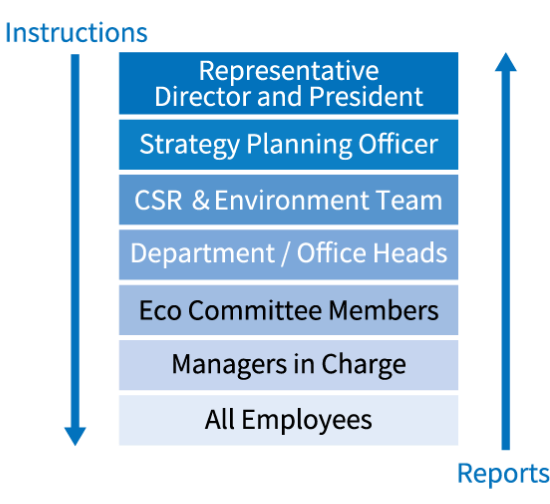
Environmental Management System
Recognizing that "achieving sustainable management," as stated in our business philosophy, will lead to an increase in corporate value, we have established an environmental management system to implement a PDCA cycle for specific environmental management measures aimed at achieving this goal. We are continuously striving for improvement.
Eco Action 21
TOREI and TFL (*) have obtained Eco Action 21, a unique Environmental Management System (EMS) formulated by the Ministry of the Environment in Japan, and their compliance with the requirements is evaluated annually by a third party. By adopting the Environmental Management System based on Eco Action 21, we are not only complying with environmental laws, but also creating a system for continuous improvement and developing manuals for environmental responses. This has not only raised environmental awareness within the company but also had a ripple effect on external stakeholders.
(*) Toyo Refrigerated Food & Logistics Co., Ltd.